Do you think like Crates of Thebes?
The door-opener of Athens · c. 365–285 BC · Cynicism
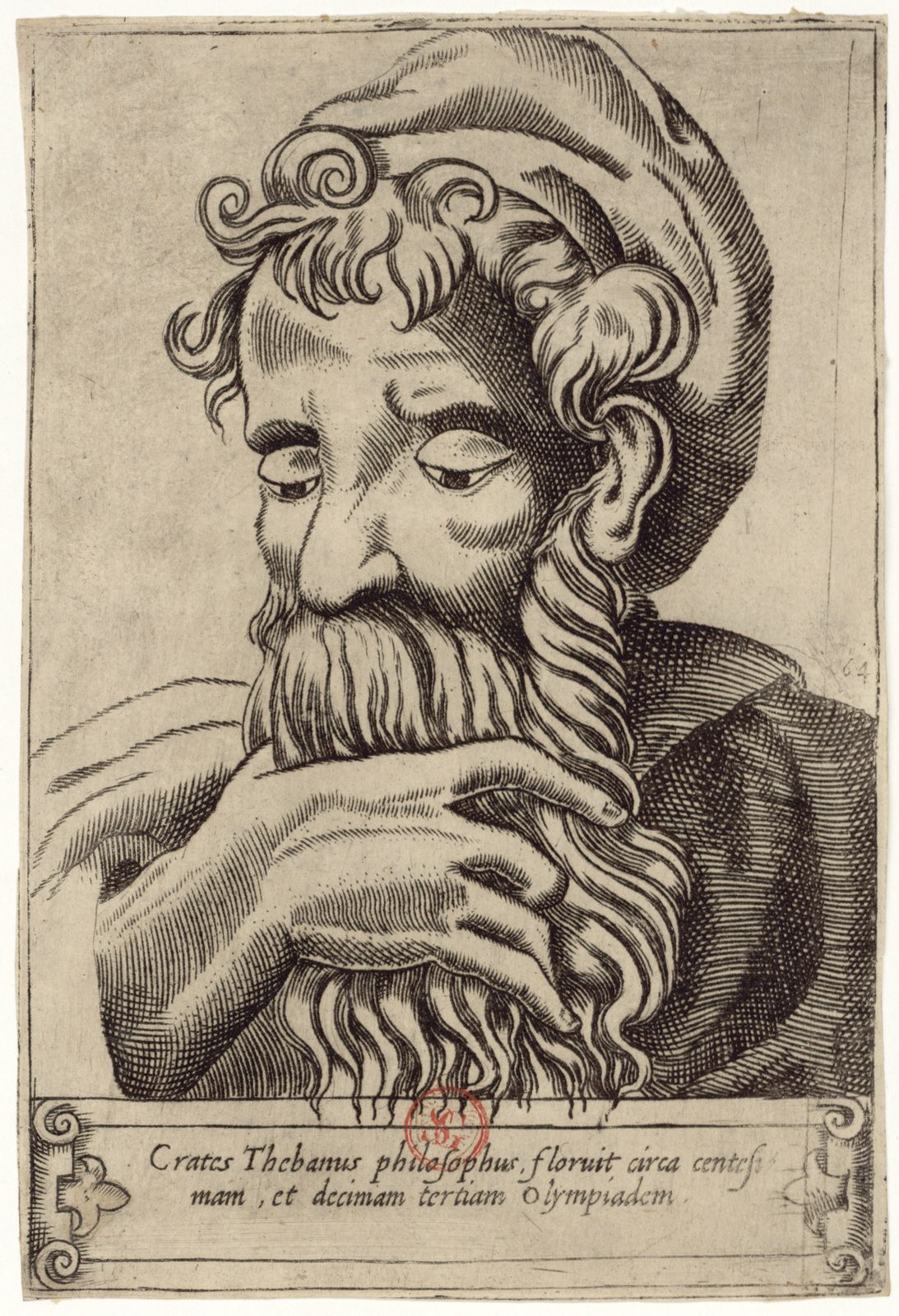
You are honest and free-spirited, but you would rather help people than shock them. That is the gentler Cynic, Crates of Thebes. He gave away a fortune to live simply, and Athenians called him the "door-opener" because he walked into homes uninvited to settle quarrels and give advice. He married the philosopher Hipparchia, who chose his way of life as an equal. Take the free test to see which philosopher you are most like.
Who was Crates of Thebes?
A wealthy man from Thebes who gave away his fortune to live as a Cynic, after Diogenes. Gentler than his teacher, he was welcomed into Athenian homes to settle quarrels, and married the philosopher Hipparchia, who chose the same life.
Cynic freedom worn lightly, with good humour.
What Crates of Thebes believed
- 1
Wealth is a weight
Possessions tie you down. Giving them away was, for Crates, a way of buying freedom.
- 2
Freedom with kindness
Cynic bluntness can be used to help. Crates used it to make peace in families, not to humiliate.
- 3
Equals in the simple life
His partnership with Hipparchia, who lived as a Cynic philosopher in her own right, broke the customs of their time.
Signs you think like Crates of Thebes
- Nature over custom. Rules must earn your respect; you do things your way.
- Will. You rely on discipline and effort.
- Virtue. Doing the right thing comes first, even when it costs you.
Crates of Thebes in nine traits
The test measures nine traits. This chart shows where Crates of Thebes sits on each one: the further a point is from the centre, the more the thinking leans toward the word printed there.
In Crates of Thebes's words
“There is a city Pera in the midst of wine-dark vapour, / Fair, fruitful, passing squalid, owning nought”
Verses attributed to Crates, in Diogenes Laertius, Lives VI.85, tr. R. D. Hicks ('Pera' is the beggar's wallet)
Where to start reading
Diogenes Laertius, Lives of Eminent Philosophers, Book VI (3rd century CE)
The main source for Crates and Hipparchia, including his surviving verses.
Plutarch, On Tranquillity of Mind (c. 100 CE)
Holds up Crates as the man who laughed his way through life.
Apuleius, Florida 14 and 22 (2nd century CE)
A Roman orator's admiring sketches of Crates as a household peacemaker.
Philosophers who think like Crates of Thebes
- Diogenes of Sinope
Shameless honesty and freedom from status.
- Simone de Beauvoir
Freedom that refuses to stop at yourself.
- Jean-Paul Sartre
Radical freedom, and full responsibility for it.
Crates of Thebes belongs to the Cynic school. Are you a Cynic?
31 situations · about 12 minutes · free result